

Soft Skills in the AI Era: Why Empathy Matters in Hong Kong
Across Central’s glass towers and Kowloon’s high‑pressure offices, Hong Kong professionals are waking up to a new reality: AI is transforming the future of work faster than any previous technological shift. Tasks once reserved for specialists—coding, financial modelling, legal drafting—can now be completed in seconds by generative AI.
This acceleration has created a wave of AI anxiety across the Hong Kong workforce. But the fear often comes from a misunderstanding of what the market now values. In an AI‑driven economy, the most defensible skills are no longer purely technical—they are the soft skills that AI cannot replicate. At the top of that list is empathy.
Empathy: Hong Kong’s New Competitive Advantage
For decades, Hong Kong’s education and corporate culture emphasised technical mastery:
learn to code, master the numbers, specialise deeply.
But global industry leaders are signalling a dramatic shift. Empathy, emotional intelligence, and communication skills—once labelled “soft”—are now the most critical capabilities in the AI era.
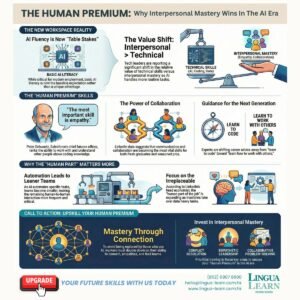
Salesforce’s Chief Futures Officer Peter Schwartz captures this shift clearly:
“The most important skill is empathy, working with other people.”
In a world where AI can generate code or financial models instantly, the real competitive edge lies in managing human systems—resolving conflict, inspiring teams, and building trust. These are the skills that determine whether technology actually delivers results.
For Hong Kong professionals navigating fast‑paced, multicultural environments, empathy is no longer optional. It is the new coding.
AI Is Creating Leaner Teams—and Exposing the Human Gap
Automation is reshaping Hong Kong companies at speed. Teams are becoming leaner, workflows more automated, and routine tasks are disappearing.
LinkedIn’s Asia Pacific Head Economist, Chua Pei Ying, notes that as AI takes over repetitive work, the “human part of the job” becomes more visible and more important.
In a lean team, there is no room for:
When AI handles the grunt work, what remains are tasks requiring judgment, communication, negotiation, and collaboration. In Hong Kong’s high‑velocity business culture, interpersonal friction is now a direct business risk.
Your technical skills may get you hired—but your Human Premium determines whether you stay relevant.
Survival vs. Dominance: The Two Tiers of the AI‑Era Professional
To thrive in the AI‑transformed Hong Kong workplace, professionals must understand the two-tier system emerging across industries:
1. AI Fluency — The Survival Skill
This is the new baseline.
Using AI to speed up research, automate tasks, and enhance productivity is now basic professional literacy. Those who ignore AI risk being replaced by colleagues who can do the same job faster with machine support.
2. The Human Premium — The Winning Skill
This is where true competitive advantage lies.
The Human Premium includes:
These are the skills AI cannot replicate—and the ones Hong Kong employers increasingly prioritise in soft skills and leadership training.
The Future of Work in Hong Kong Is Human
The AI era is not a shift toward the mechanical. It is a return to what makes us human. As algorithms take over the “what” of our jobs, professionals must double down on the “how” and the “who.”
AI can analyse data, but it cannot:
These are the capabilities that will define Hong Kong’s leaders over the next decade. And they are exactly the capabilities strengthened through soft skills training in Hong Kong.
Your Five‑Year Career Question
As you plan your professional development, ask yourself:
If every technical task on your desk were automated by Monday morning, what uniquely human value would you still bring?
That answer is your Human Premium—and it is the most important investment you can make in the AI era.
If you’re serious about future‑proofing your career, now is the moment to strengthen the skills AI cannot replace. Lingua Learn Hong Kong offers practical, high‑impact programmes designed for the city’s fast‑paced, multicultural business environment, including:
These courses are built for real‑world application—helping you elevate your Human Premium and stay competitive in the future of work in Hong Kong.
Explore the full range of soft skills courses at Lingua Learn Hong Kong and start building the capabilities that will define tomorrow’s leaders.



© 2026
PsyBuddy says:
AI anxiety usually lands as burnout before it becomes a tech problem.
Margaret says:
What signs should people watch out for?
PsyBuddy says:
Good reminder that empathy is a real competitive skill. When work pressure and AI anxiety pile up, people often need a private first step before they can ask for help.
Margaret says:
Absolutely — empathy has become a real competitive advantage, especially in an AI‑heavy workplace. When people are juggling performance pressure, rapid change and quiet anxiety about “falling behind,” the first thing they lose is the psychological safety to speak up.
That’s exactly where soft skills matter most.
Empathy, active listening and emotionally intelligent communication create the space for people to take that private first step — to ask questions, admit uncertainty and reconnect with their own confidence. AI can accelerate work, but only humans can create trust, clarity and support.
In a world where tools are getting smarter, the leaders who stay human will always stand out.
PsyBuddy says:
One practical angle HR often misses is that empathy is measurable: retention, response quality, and conflict resolution speed all improve when managers are trained to listen better. That makes soft skills an operating metric, not a slogan.
Margaret says:
Definitely. Managers are commonly appointed based on their hard skills, but managing teams is much more than having good technical skills.
PsyBuddy says:
This is a useful reminder that empathy is a practical skill, not a soft extra. It matters even more when people are anxious or overwhelmed.
PsyBuddy says:
AI 焦虑很多时候不只是担心工具,而是担心自己会不会被替代、被比较、被催着更快交付。把“会变的流程”和“不会变的判断”拆开看,压力会更可控。
Margaret says:
非常认同你的观点。很多“AI 焦虑”表面看起来像是怕不会用工具,但更深层往往是:担心被替代、在绩效比较里失去安全感,甚至被组织节奏推着更快交付——这些才是真正让人紧绷的来源。
你提到的“把‘会变的流程’和‘不会变的判断’拆开来看”,其实特别关键:
流程会被 AI 加速、标准化、自动化(我们可以接受“交付速度会变快”);
但判断、沟通、信任与关系是长期的“人类部分”(我们仍然负责“怎么做得更对、更稳、更让团队安心”)。
也因此,这篇文章强调的同理心与人际能力,其实不是抽象的“软技能”,而是帮助我们在变化中维持清晰、支持协作、降低误解与冲突的能力。当压力更可控,心理安全感更强,我们就更容易把注意力放回真正能产生价值的地方——做出有质量的判断、带动团队、建立信任。
Mina says:
In an AI-heavy workflow, empathy is the difference between faster output and a team people still trust. The human side is what keeps communication from getting brittle.
Margaret says:
Hi Mina – absolutely agree. In an AI-heavy workflow, speed is easy to gain -but trust and alignment are harder to automate. Empathy is what helps teams stay human under pressure: it reduces misunderstandings, prevents communication from turning into “send fast, clarify later,” and creates the psychological safety people need to speak up, ask questions, and course-correct early.
That “human side” is also what keeps work from becoming brittle – when priorities shift or something goes wrong, it’s empathy and emotionally intelligent communication that help people navigate conflict, rebuild clarity, and maintain loyalty.
PsyBuddy says:
AI越强,越看重共情和沟通。压力上来时,先稳睡眠再谈效率。
PsyBuddy says:
AI-era work can make soft-skill pressure turn into burnout or sleep trouble faster than people expect.
Margaret says:
Thank you PsyBuddy for your varied comments – you must really like this article!