
AI and soft skills in Hong Kong are now two sides of the same talent strategy. As AI adoption accelerates, technical tools are turning routine execution into a commodity. In seconds, AI can summarise a report, review code or draft a document. However, it cannot negotiate a high-stakes deal, navigate cross-cultural dynamics or lead a team through uncertainty.
As a result, the real competitive edge has moved. Organisations now need to pair technical tools with strong human skills and clear communication frameworks.
In this post, you will learn:
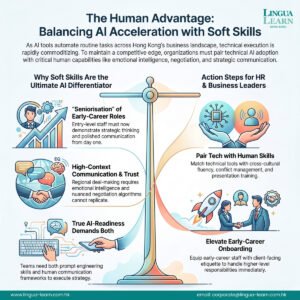
AI now handles much of the routine analytical and administrative work that once filled a junior employee’s day. Consequently, expectations for early-career roles have risen sharply. We call this the “seniorisation” of junior positions.
Graduates are no longer hired only to complete routine operational tasks. Instead, employers expect them to show:
Moreover, employers expect all of this from day one. The baseline for early-career talent has shifted from task execution to immediate strategic impact.
Junior professionals are stepping into stakeholder-facing roles earlier than ever. Therefore, interpersonal capability matters more than before. This is especially true in Hong Kong, where business relationships span regions, cultures and generations.
AI is excellent at processing information. Yet a gap remains between generating data and acting on it with people. Algorithms lack emotional context and situational awareness. Put simply, AI can produce data, but it cannot read a room.
Building trust with regional partners, institutional stakeholders and multigenerational teams relies on human strengths:
These cross-cultural communication skills build lasting relationships, and software cannot replicate them.
Many business leaders assume that an AI-ready workforce is a technical challenge. In this view, teaching employees to write good prompts is enough.
In reality, readiness requires a broader strategy. A team trained only in prompt engineering may produce a high volume of analysis. Without communication frameworks, however, that output rarely turns into strategic decisions or business results.
In other words, tools alone do not deliver outcomes. Teams also need the interpersonal skills to present insights, persuade stakeholders and execute strategy. True AI readiness therefore combines two investments: technical upskilling and soft skills training.
The global data points the same way. The World Economic Forum Future of Jobs Report 2025 draws on input from more than 1,000 employers across 55 economies. It found that 67% of employers treat resilience, flexibility and agility as core skills, and 61% say the same of leadership and social influence. A Euronews analysis of the report adds that analytical thinking ranks first, with creative thinking also seen as a key skill. These figures are global rather than specific to Hong Kong. Even so, they show that employers value adaptive and interpersonal strengths alongside technical ability, which strengthens the case for pairing AI upskilling with structured soft skills training.
To maximise the return on technology investment, HR and business leaders can start with two priorities.
Match every technical AI rollout with structured training in:
This pairing helps ensure that technical output leads to actionable strategy.
Update onboarding programmes to give junior staff client-facing etiquette and clear communication frameworks. As a result, new hires can take on strategic responsibility with confidence from their first day.
AI automates routine tasks, so the work that remains depends on judgement, trust and communication. These are human strengths, and they now set professionals apart.
Emotional intelligence, cultural awareness, negotiation, conflict management and clear presentation skills are all increasingly valuable. Each supports high-context business communication.
Combine technical training, such as prompt writing and tool use, with structured communication and cross-cultural training. This ensures AI output becomes real business decisions.
AI and soft skills in Hong Kong must develop together. Organisations that focus only on deploying technology risk producing analysis that neither builds trust nor drives action. Sustainable advantage comes from a deliberate balance between cutting-edge AI and advanced human communication skills.
What is your organisation doing to balance AI adoption with soft skills development? Share your experience in the comments. Which human skills have become more critical as AI use has grown?
Ready to equip your team? Explore our communication and cross-cultural training programmes at Lingua Learn Hong Kong.
#AIandSoftSkills #HongKong #AIReadyWorkforce #SoftSkills #FutureOfWork #HongKongBusiness #HKJobs #HKTalent #HRLeaders #LearningAndDevelopment


© 2026